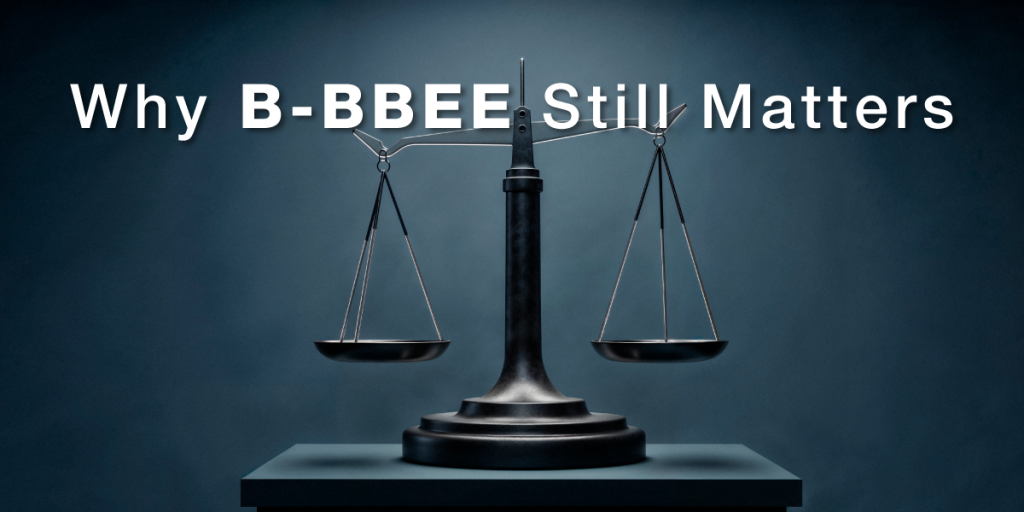
South Africa is at a fascinating crossroads. On one hand, our economy remains tied to global partners like the United States, where shifts in trade policy and politics can reshape our future overnight. On the other, fierce local debates are stirring around Broad-Based Black Economic Empowerment (B-BBEE or BEE). As business leaders, we’re caught between global competitiveness and local transformation, questioning whether BEE still drives meaningful change or simply creates obstacles.
The bigger picture: politics, trade and local shifts
With the US being a crucial trade partner, especially under AGOA, South African companies rely heavily on that access. But economic ties also come with scrutiny and foreign investors, including those in the United States, have raised concerns that South Africa’s BEE policies may hinder investment. Against this backdrop, BEE receives mixed reactions – welcomed by some as a corrective measure, questioned by others as a trade barrier.
Domestically, the debates hit even harder. President Cyril Ramaphosa continues to defend BEE as essential for redressing inequality. At the Black Business Council Summit Gala, he dismissed the idea that BEE “is a cost to the economy,” arguing instead that “it is an investment in the economy” (SABC News). He’s also pushing for a R100 billion Transformation Fund, encouraging banks and firms to channel ~3% of their post-tax profits to empower black enterprises (BusinessTech).
Yet the conversation is far from one-sided. While many support the moral imperative of transformation, others raise concerns about how BEE is implemented and whether it’s delivering broad-based impact.
The case for BEE
- Fixing historical inequality: Apartheid’s legacy excluded the majority from ownership, education and leadership. BEE aims to rebalance that, putting black South Africans in roles of ownership and influence – not just as workers, but as shareholders, executives and entrepreneurs.
- Stability breeds business confidence:High inequality is more than an injustice, it’s a risk. Unrest, protests, and policy uncertainty disrupt business environments. Companies that invest in transformation are actually investing in a more stable, predictable future.
- Market access and procurement: In South Africa, BEE scores influence access to government contracts, supply chains and even corporate partnerships. For many businesses, transformation isn’t ideology, it’s competitive reality.
- Aligning with global ESG trends:Sustainability-minded investors increasingly look for inclusive growth. BEE dovetails with Environmental, Social and Governance (ESG) frameworks – meaning compliance at home can signal responsibility abroad.
The case against BEE
- Elite capture and recycling:Professor William Gumede warns that over R1 trillion has been transferred under BEE to fewer than 100 politically connected individuals, raising serious concerns about elite capture and the recycling of beneficiaries. While BEE has enabled some broad-based schemes, its implementation has too often served a narrow circle. Gumede argues that true empowerment means creating millions of economically active citizens, not just a handful of billionaires.
- Labour market inequality persists:Professor Imraan Valodia’s research shows that despite BEE and Employment Equity legislation, Black South Africans and women continue to face wage gaps and occupational segregation. Ownership transformation hasn’t always translated into workplace equity or skills development. Valodia emphasises that transformation must go beyond boardrooms and balance sheets – it must reach the factory floor and the training room.
- Investor hesitation:Complexity and opacity in BEE regulations can deter foreign investment. Gumede notes that the current model sometimes incentivises fronting and rent-seeking, rather than genuine entrepreneurship. When transformation becomes a compliance exercise rather than a strategic imperative, it risks alienating capital.
- Missed opportunity for broader impact:Both Gumede and Valodia highlight that BEE’s potential lies in its ability to catalyze inclusive growth, not just ownership. When it’s reduced to a tick-box exercise, it fails to address deeper structural inequalities. The challenge isn’t whether BEE should exist, it’s how to make it work better.
Widening the perspective: Facts & real voices
A recent TechFinancials article exploring the mining sector’s competitiveness posed a provocative question: “BEE must remain… but does it have to include mandatory ownership?” This sentiment, echoed in broader investor commentary, suggests that flexibility in equity requirements could unlock growth without abandoning transformation goals (TechFinancials).
The DA’s John Steenhuisen recently told Reuters that the US is linking trade progression to race-based policies like BEE, signalling the importance of reform for smoother negotiations.
Meanwhile, Gumede points to models like Sasol Inzalo and Absa’s employee and community trusts as examples of inclusive BEE done right. These schemes go beyond elite capture, extending ownership and dividends to thousands of ordinary South Africans.
The honest answer: Yes, but…
Here’s the truth: BEE still matters, but it must be smarter. The moral and economic case is clear – South Africa can’t thrive if most people remain excluded. Yet critics aren’t baseless: BEE has been misapplied, made complex and manipulated. The real challenge now is making it transparent, inclusive and impactful without alienating investors.
For business leaders, this isn’t just a policy issue – it’s a strategic one. Transformation is unfinished. And in today’s climate where trade complexities and social expectations are rising, BEE can either be a burden or a lever for legitimacy and growth.
Where business leaders can step up
Instead of waiting for legislation to catch up, business leaders can be the change:
- Invest in skills: Focus on mentorship, training and long-term capacity building, rather than ownership alone.
- Support emerging entrepreneurs: Work with black-owned suppliers in impactful ways, not just paper partnerships.
- Think broad: Avoid reinforcing elite capture. Empowerment should extend to diverse and large-scale participation.
- Frame BEE as strategic: Position BEE components as part of ESG and sustainability initiatives that investors appreciate.
Final word
In today’s political and economic landscape, businesses face a choice: treat BEE as a compliance burden, or embrace it as a strategic tool for long-term growth, legitimacy and stability.
Yes, BEE must evolve. Yes, we have to guard against abuse. But scrapping it isn’t the answer. The scaffolding is still needed, it just needs repair. Transformation is unfinished. And for forward-looking businesses, leader-level engagement in BEE isn’t just ethical, it’s smart strategy for the future.