
(Article #2 in the series “From Matric Myths to Meaningful Pipelines”)
In the first article, I spoke about how matric has slowly become an entry requirement it was never really meant to be. When we treat school results as proof of workplace readiness, we start with the wrong assumptions.
What I want to explore here is how those same assumptions don’t stop at hiring. They show up again and again in how employers approach transformation, youth programmes and skills development.
Over the years, I’ve been part of many conversations about B-BBEE where the intent of the framework is broadly understood, but the way it plays out feels very different. B-BBEE was created to address inequality, including gaps in education and access to skills, which is why skills development sits so firmly within the scorecard.
In practice, however, many organisations experience B-BBEE as another area of compliance that needs to sit alongside existing hiring and employment-ready policies. There is often an unspoken assumption that by the time young people enter the labour market, the education system will have equipped them sufficiently, and that skills development programmes are there to refine or top up that readiness.
Where the basic education system doesn’t fully support that assumption, the tension starts to show. Programmes struggle not because the intent is wrong, but because the starting point is misread.
Tools like B-BBEE, YES and the broader skills development framework are designed to work in a system where a regular intake of young people enters the labour market each year, allowing employers to place them, develop them and, where possible, absorb them over time.
In reality, what tends to happen is quieter.
Companies remain compliant. Budgets are allocated. Programmes run. Reports are submitted. But when you look back a year or two later, very little seems to have carried forward.
In my experience, most employers don’t resist transformation. What they struggle with is the feeling of doing the same thing year after year without seeing real change.
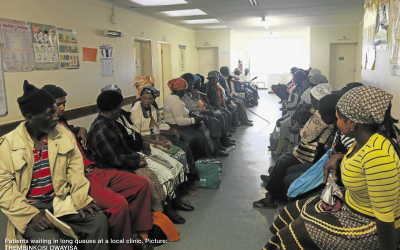
The pattern is familiar. Each year, a youth programme is launched. Young people are placed for a fixed period. Paperwork is completed. And the following year, the process starts again.
On paper, everything looks fine. In reality, it can feel like a treadmill.
It’s easy to describe this as box ticking, but I don’t think that tells the full story. What I see more often is employers responding to how the system measures success. When participation is what counts, effort naturally goes into meeting those visible requirements. The work gets done, but the outcomes don’t always stick.
Part of the reason is that transformation programmes don’t sit at the start of the system. They sit at the end of it.
Employers are asked to work with young people whose schooling they didn’t shape, using tools that were designed to build capability over time. When those tools are instead treated as extensions of academic entry criteria, their purpose starts to break down.
This is particularly visible in how occupational pathways and learnerships are used.
Many of these programmes were designed specifically for people who did not follow a traditional academic route. Early school leavers. Higher Certificate candidates. Individuals who learn best by doing and by being in practical environments. In many ways, these pathways were created for the average South African who did not have access to mainstream higher education because of where they came from.
Occupationally directed training allows people to learn on the job, build competence over time and, in many cases, achieve outcomes that are equivalent to those reached through formal higher education. Entry into these programmes often does not require matric, or requires only a very basic level of academic attainment.
That is not a weakness. It is the design.
Yet in practice, access to many of these programmes is still limited to matriculants only. This is rarely done out of exclusion. It comes from applying the same assumptions used in recruitment to programmes that were meant to work differently.
When that happens, programmes underperform. Employers become frustrated. And the framework itself is blamed, rather than the assumptions shaping how it is being used.
This isn’t about fault. It’s about understanding the tools properly.
One of the clearest contrasts I’ve seen is in sectors like mining, manufacturing and certain technical trades. These industries have long histories of occupational training and apprenticeship-style development. Where employers understand the difference between academic pathways and occupational ones, and design programmes accordingly, absorption and progression tend to be stronger.
The difference is not commitment. It is alignment.
One of the biggest distinctions I’ve seen between programmes that stall and those that begin to work is continuity. Not whether an employer participates, but whether they build on what they’ve already done.
Progress starts to show when programmes are embedded rather than restarted each year, when participants are placed into roles that genuinely lead somewhere, and when people are able to move from entry-level occupational training into more advanced qualifications over time.
Employers can’t fix the education system. They can’t solve unemployment on their own. And they can’t replace the role of government.
What they can do is become more deliberate about how they use the tools available to them. That means recognising when occupational and learnership pathways are more appropriate than academic filters, and resisting the instinct to force every entry point to look like matric-based recruitment.
This isn’t about ideology or compliance points.
It’s about understanding how the system was designed to work, and using it accordingly.
Taken together, these experiences help explain why transformation can feel busy, expensive and yet strangely ineffective, even when everyone involved is acting in good faith.