
Some say, “It’s just a word.”
Maybe. But words have a funny way of shaping how we think, and how other people think too.
When it comes to disability, the language we use can either reinforce outdated stereotypes or help create a more inclusive and respectful view of disability. And while nobody expects you to have a dictionary open every time you speak, being mindful of the words we choose is an important part of building genuinely inclusive workplaces and communities.
It’s about the person first
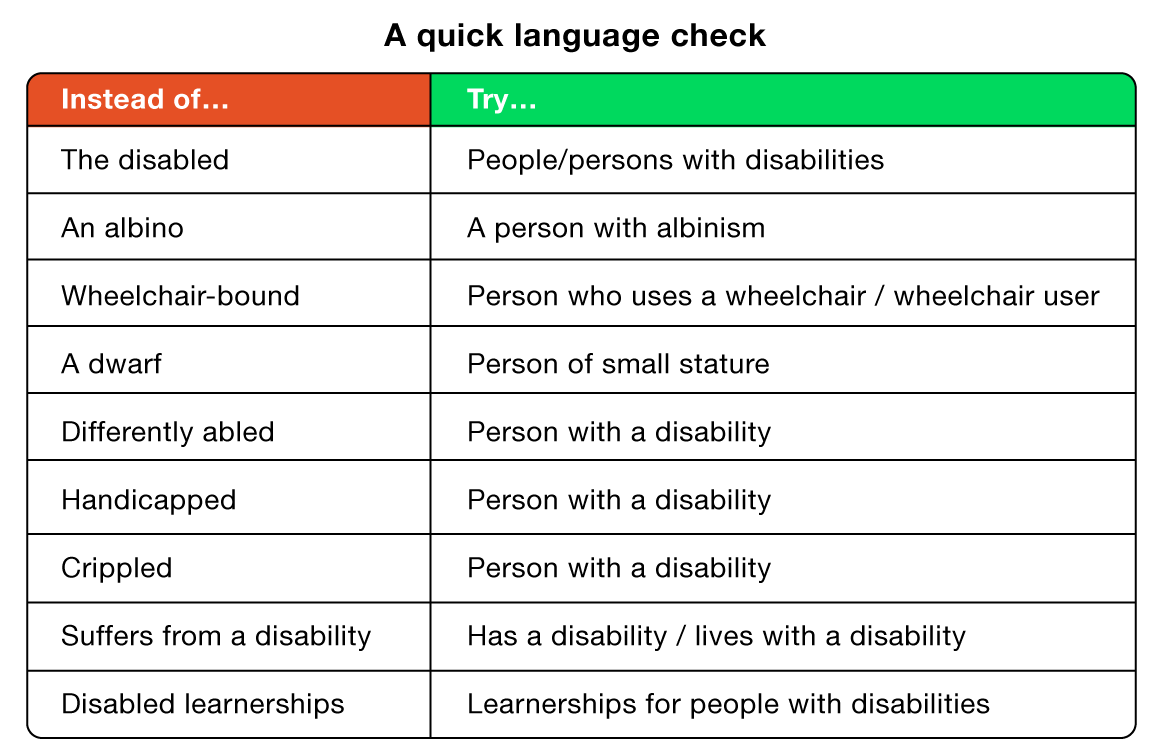
One of the simplest principles to remember is person-first language: talk about the person, not the disability as though it defines them.
For example:
✕ “The disabled”
✓ “People/persons with disabilities”
✕ “An albino”
✓ “A person with albinism”
✕ “A dwarf”
✓ “A person of small stature”
The difference may seem subtle, but it sends a very different message. A person’s disability or condition is one aspect of who they are, it isn’t their entire identity.
And yes, this can take a little getting used to. But then again, so did remembering not to put your mask on upside down during the pandemic.
Let’s set the wheelchair free!
One of the most common phrases we hear is “wheelchair-bound.”
It sounds harmless enough, but think about the image it creates: someone bound to a wheelchair, almost as if they are imprisoned by it.
The reality can be quite the opposite.
A wheelchair is a mobility tool that gives a person independence, freedom and the ability to participate in everyday life.
So rather than:
✕ “She is wheelchair-bound.”
Try:
✓ “She is a wheelchair user.”
or
✓ “She uses a wheelchair.”
The wheelchair isn’t holding the person back. In many cases, it’s helping them move forward.
“Differently abled” – well-intentioned, but not quite right
Another term that often appears with good intentions is “differently abled.”
It sounds positive, doesn’t it? Unfortunately, it isn’t considered the preferred terminology.
Why? Because it can unintentionally avoid the reality of disability rather than recognising it. Disability is not something that needs to be dressed up in nicer-sounding language.
The preferred terminology is simply:
✕ “Differently abled person”
✓ “Person with a disability”
There is nothing negative about acknowledging disability. In fact, using the correct terminology helps us have more honest and meaningful conversations about accessibility, inclusion and equality.
Some words belong in the history books
Words such as “handicapped” are outdated and can be considered derogatory. They are rooted in historical ways of thinking about disability that we have thankfully moved beyond.
Similarly, terms such as “crippled,” “invalid” or using disability-related terms as insults are inappropriate and should be left firmly in the past.
The important thing is not to panic if you realise you’ve used the wrong term. Nobody expects perfection. If you make a mistake, correct yourself and move on.
“Sorry, I meant person with a disability.”
That’s it. No dramatic apology tour required.
Why does all of this matter?
Because language shapes mindsets.
The words we use influence how disability is perceived – by employers, colleagues, educators, communities and, importantly, by people with disabilities themselves.
Language that focuses on limitations can reinforce the idea that disability is something negative or something that needs to be overcome.
Language that focuses on the person, their abilities, their choices and their participation helps shift the conversation towards inclusion and equality.
And this matters in the workplace.
If an organisation genuinely wants to create an inclusive workplace, it needs to go beyond policies and tick-box exercises. Inclusion is also reflected in everyday conversations, recruitment practices, workplace interactions and the language people use.
When in doubt, ask
There isn’t always one universal rule for every situation.
The best approach? Respect the individual’s preference.
If you’re unsure, ask. It’s far better to say, “What terminology do you prefer?” than to make assumptions.
The bottom line
Inclusive language isn’t about walking on eggshells. It’s about being thoughtful.
We all have words we use out of habit, and sometimes those habits are outdated. The good news is that changing our language is one of the easiest ways to start changing perceptions.
So, the next time you talk about disability, take a second to think about the words you’re using.
Because words don’t just describe the world we live in, they can help shape the world we create.
And that’s a conversation worth having.